
Snoring Mouth Guard: How It Works and Who It Suits
Some patients tell me about their snoring as a simple night inconvenience. Others, on the other hand, evoke cut nights, exhausting awakenings or a sleep that has become conflicting in the couple. What strikes me is that snoring is often minimized while it can profoundly affect the quality of life.
I am Dr. Solène Vo Quang, oral surgeon in Paris at 7 rue Marbeau. In my practice, I regularly see patients affected by sleep disorders, whether in connection with bruxism, obstructed breathing or mild apnea. Among the devices I have to recommend, the anti-snoring mouth guard It's a growing place.
What is an anti-snoring mouth guard and how does it work?
Definition of an anti-snoring mouth guard
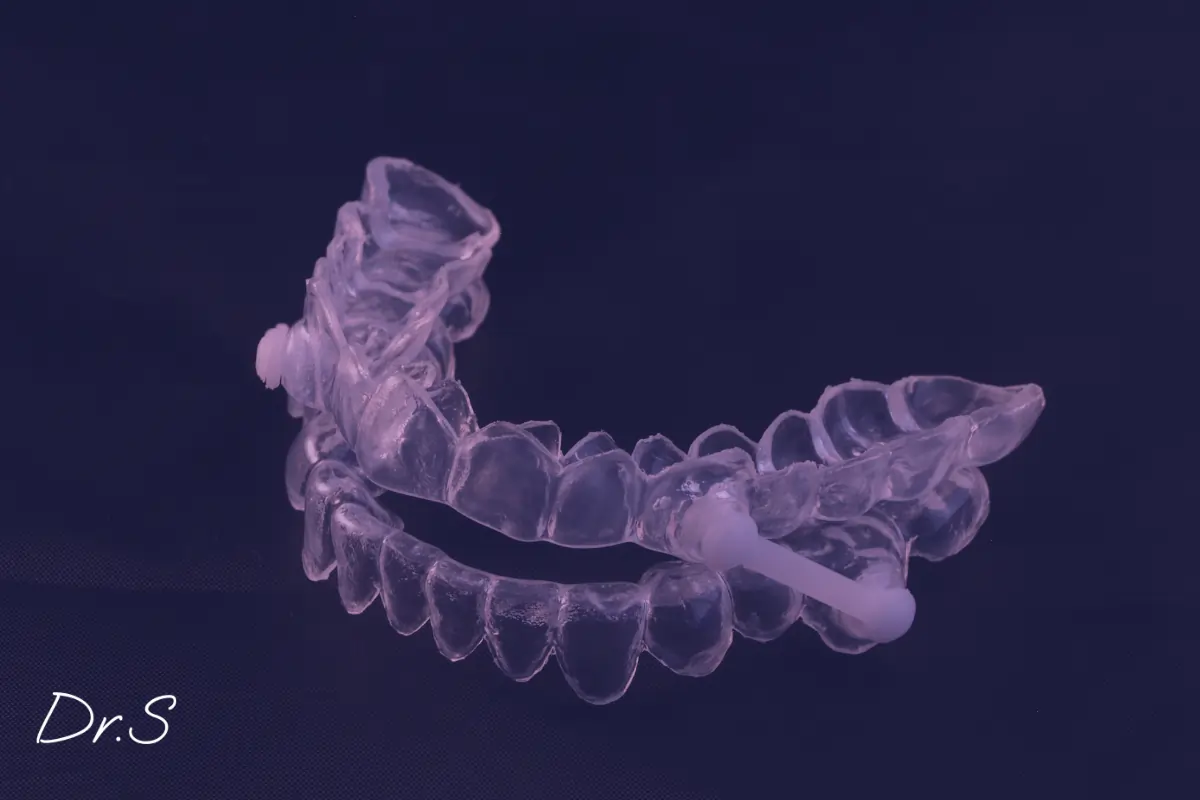
The anti-snoring mouth guard is a oral device, often prescribed when snoring comes from narrowing the respiratory tract during sleep. It wears at night, at the level of the teeth, and acts mechanically on the position of the lower jaw.
Its aim is not to silence a symptom, but to facilitate the passage of air by limiting the vibrations at the origin of the noise. It is therefore indicated mainly for so-called "obstructive" snoring, of oro-pharyngeal origin.
Difference between gutter and mandibular orthotics
The term mandibular orthosis refers to a specific category of gutters, whose role is to maintain the advanced jaw during sleep. All mandibulary orthotics are gutters, but not all gutters are designed to advance the mandibulal.
This distinction may seem technical, but it is important for the choice of suitable device. Theorthesis acts on the anatomical cause of snoring, while a conventional gutter can just stabilize the jaw without active correction.
Who is the anti-snoring mouth guard for?
Profiles and medical indications
I am referring to a mandibular orthosis of patients with regular, annoying snoring, but without severe apnea detected in the sleep test. It is particularly useful in cases of mild or moderate sleep apnea, or when ventilation mask intolerance (PCAC type) becomes problematic.
It can also accompany associated disorders such as bruxism or certain forms of chronic fatigue. The issue is then to make the diagnosis well before any prescription.
Contraindications and precautions to be known
There are situations where the laying of an orthotic is not recommended. For example, in cases of significant dental mobility, joint damage to the jaw, or severe untreated apnea.
This is why a complete oral balance is essential, as is an evaluation of sleep, sometimes with polysomnography. In case of doubt, I recommend a specialist opinion in pneumology or sleep medicine.
How does a mandibular orthosis work?
Principle of mandibular advancement
The orthosis acts by keeping the lower jaw (mandible) in a slightly advanced position at night. This controlled shift avoids the loosening of soft tissue which, by recoiling, obstructs the passage of air.
The patient thus breathes more freely through the throat, which reduces the vibrational phenomena causing the noise. This is not a forced action, but a gentle and progressive correction.
Effects on upper respiratory tract
By repositioning the mandible, the orthosis mechanically enlarges the oro-pharyngeal space. This optimizes night ventilation, improves sleep oxygenation and reduces micro-rearings related to respiratory effort.
Studies show a significant reduction in snoring in the majority of cases, with an improvement in the quality of life of the couples concerned.
In my practice, I observe that the gutter is all the more effective as it integrates into a comprehensive and accompanied approach.
Choosing your anti-snoring mouth guard: the essential criteria
Criteria of choice to consider
Several elements are considered: comfort, stability, ease of adjustment and materials used, often in thermoformable resin. A good gutter must be well tolerated, especially during the first weeks.
The oral adaptation, personalized, allows to limit muscle tensions, joint pain or nausea. That's why I advise against generic models without medical guidance.
Standard or custom Gutter?
Standard models, sold online or in pharmacy, may be suitable on an ad hoc basis, but rarely offer lasting adaptation. Their rigid or approximate shape may interfere with the jaw or cause persistent discomfort.
In most cases, I prefer a custom mandibular orthosis made from dental prints. It precisely adjusts to the patient's morphology and mandibular posture.
Installation and daily use of the gutter
Installation and thermoforming
Before the first port, some gutters require thermoforming moulding at home or in the cabinet. It is a matter of softening the material with hot water, then placing it in the mouth so that it marries the shape of the teeth.
In the case of custom-made orthotics, adjustments are made finer, sometimes in several stages, with the help of the dental surgeon trained in these devices.
Tips for a comfortable night port
When a patient starts to wear orthotics, I recommend a gradual adaptation: a few hours on the first night, then the entire duration of sleep when comfort is on the appointment.
In case of sensations of temporary discomfort, it is important to check the settings or adapt the amplitudes of mandibular progression. Regularity in the port also helps to stabilize the effects.
Maintenance, life and replacement
Cleaning and daily hygiene
Like any oral device, strict hygiene is paramount. I recommend cleaning the gutter every morning with a soft brush, warm water and possibly a suitable non-abrasive cleaner.
Wet areas between the dental edges should also be avoided, where bacteria can be housed. Complete drying before storage is preferable to limit microbial development.
When and how to replace your gutter
The life of an orthotic depends on its use and the quality of the materials. In general, it can last between one and three years. The signs of wear include loss of hold, cracks or sudden discomfort.
Regular monitoring can anticipate the necessary adjustments or replacement at the right time. This also avoids the progressive loss of efficacy that patients do not always perceive.
Are the anti-snoring gutters really working? Medical advice
Yeah, but not all of them. An anti-snoring mouth guard, also known as orthotic, dental or anti-snoring mouth guard, slightly advances the jaw during sleep to clear the air passage. Reviews are divided because models sold in pharmacies are not suitable for your jaw.
In pharmacy or custom? The thermoformed models sold in pharmacies cost a few dozen euros and are suitable for simple snoring. They move, they sometimes hurt the gums and they twist. The best anti-snoring mouth guard remains the one made to measure after examination.
What Clinical Studies Say
Clinical work shows a significant reduction in the intensity and frequency of snoring in nearly 70-80% of cases when a mandibular orthosis is correctly worn.
In some patients with mild apnea, the number of respiratory episodes may decrease, resulting in deeper sleep and improved daytime alertness.
Feedback and feedback from users
The testimonies of my patients often point to a more peaceful sleep, a better understanding within the couple and, sometimes, a return of energy in the day. But this efficiency remains linked to the proper setting and respect of the night port.
It is not uncommon to adjust the orthosis several times before finding the ideal compromise between respiratory efficiency and mandibular comfort.
Anti-snoring or other solutions: what to choose?
Gouttière vs CPAP: for what cases?
The Continuous Positive Pressure Mask (CPAP) remains the reference for severe apnea. It ensures a constant air flow that keeps the tracks open. But some patients don't support it or want a more discreet alternative.
This is where the mandibular gutter, adapted to moderate forms or mask intolerances, comes in. It offers a simpler, nomadic solution, and often better accepted in the long term.
Comparison with sprays and nasal strips
Decongestant sprays and nasal strips may temporarily improve breathing but do not act on the cause of oral snoring. Their effect is therefore limited and often transient.
The anti-snoring mouth guard, however, really alters the mechanics of air passage, restoring a stable and silent breathing space. It is a more structural than symptomatic approach.
Why consult a healthcare professional?
Role of dentist in the adaptation of orthotics
The adjustment of a mandibular orthosis is not blind. The dentist will make a fingerprint, analyze your occlusion, and propose a forward position adapted to your particular case.
It also helps prevent side effects, such as joint pain or dental movement. Monitoring over time remains essential to maintain effectiveness and tolerance.
When to consult a sleep specialist
In case of suspicion of sleep apnea, or if snoring is accompanied by significant daytime drowsiness, I recommend a check with a sleep centre. A night respiratory test can inform the diagnosis.
It is thanks to this cooperation between specialties that we can offer a truly personalized solution, secure, and aligned with your overall health.
Choosing an anti-snoring mouth guard can, for some people, transform the quality of their nights. Still, it must be well chosen, placed in a medical setting, and accompanied in time. Night breathing also deserves to be listened to with care.
Patient-centred surgery in Paris

I am Dr Solène Vo Quang.
Every day, I explore what AI can bring to care, while remembering that the relationship with each patient remains our first therapeutic tool.
I provide care with rigour and transparency.



FAQ :
anti-snoring mouth guard
Answer your questions
Can the anti-snoring mouth guard aggravate a pre-existing bruxism?

In some cases, yes. Prior assessment is essential to adapt the device without damaging joint balance.
Can an anti-snoring mouth guard be worn in case of dental prosthesis?
Depends on the type of prosthesis. Clinical analysis is used to assess the stability required to consider this option.
What signs indicate that the anti-snoring mouth guard is not well tolerated?
Joint pain, excessive salivation or sleep disorders may indicate a need for re-evaluation.
Are there long-term impacts associated with the regular night port of a gutter?
Long-term use should be monitored, in particular to monitor mandibular posture and dental occlusion.