
Night Guard for Teeth Grinding: Custom Mouth Splint
In my office at 7 rue Marbeau, in Paris, I regularly receive patients worried about their jaw pain, their teeth that wear out abnormally, or their sleep disturbed by night-time stress. These signs are often related to a discrete but common disorder: Brussels.
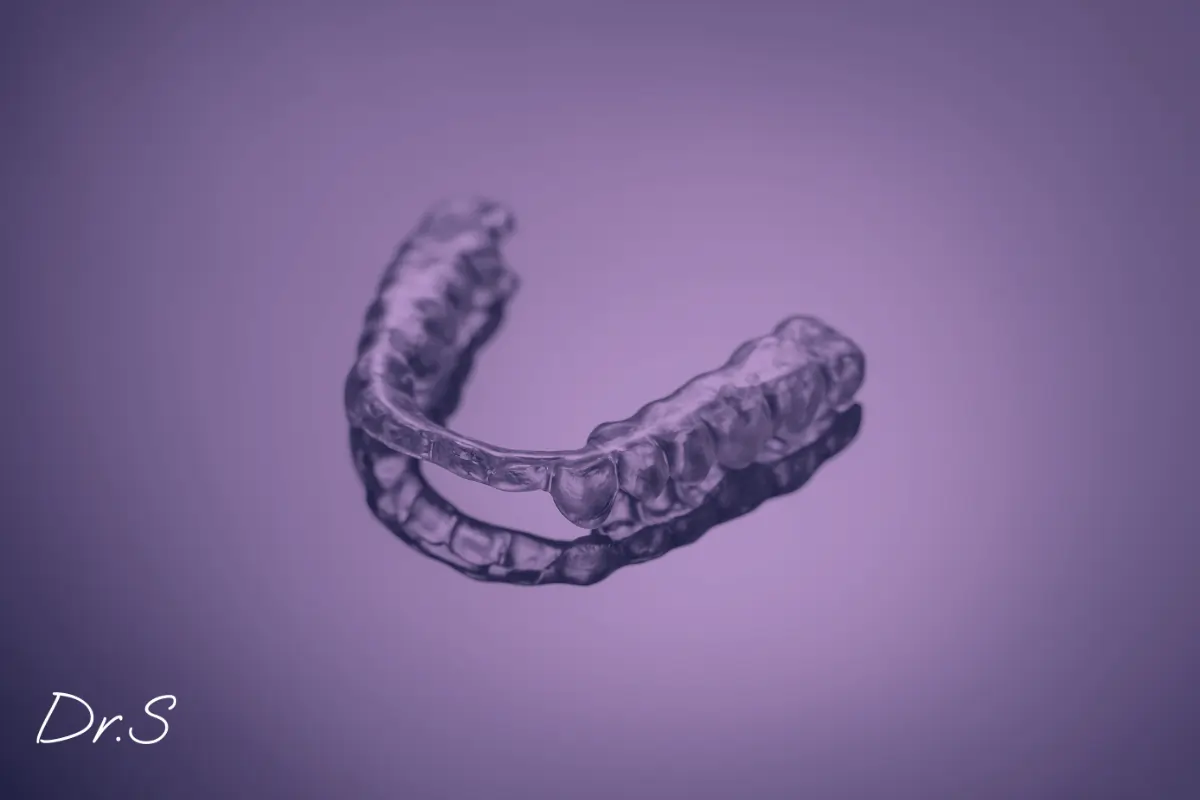
I'm Dr. Solene Vo Quang, oral surgeon. I am accompanying adults with this disorder, thanks in particular to a discreet but very useful device: night guard for bruxism, also called oral orthotics. Misused, it can be disappointing. It is well indicated and well carried and becomes a valuable tool in a comprehensive and thoughtful approach to care.
What is a night guard and what is it for against bruxism?
Definition and operation of oral orthotics
A night guard is a small device, usually made of resin, placed on the teeth, either at the top or below. It is not intended to correct a position like an orthodontic device, but it acts as a shield between your teeth.
It is used mainly at night, as bruxism often manifests itself during sleep, in the form of involuntary tightening or creaking. The gutter reduces friction, cushions pressures, and relieves muscle and joint tissue in the jaw.
Occlusal, bruxism or liberation gutter: differences
Terms vary according to the clinical context. We're talking about occlusal splint when seeking to balance the pressures between the two jaws. "bruxism gouttière" is used to highlight its use against scratches.
Rather, the term "release mould" refers to the desired muscle relaxation, especially in cases of high tension. All these names refer to devices close in shape, but with slightly different objectives depending on the symptoms observed.
Understanding bruxism: visible causes and signs
Possible origins of night bruxism
bruxism does not have a single cause. Chronic stress often plays an important role. But other factors may occur: an imbalance between the teeth, disturbed breathing, chronic pain, or sleep disorders.
So it's not just a night tick. It is often a symptom of a more global imbalance, which should be understood first of all.
Symptoms experienced or visible in patients
The signs can be very discreet at first. Some patients consult me with morning headaches, muscle fatigue when they wake up, or a feeling of joint shift.
Others note that Dental wear and tear, sometimes already advanced. Grinding may also be reported by the spouse. In all cases, these signals should trigger a consultation, even if the pain is intermittent.
Clinical benefits of a night guard
Prevention of dental wear and tear
The pressure exerted during bruxism episodes can reach high levels, far beyond what the teeth support on a daily basis. This weakens enamel, makes teeth sensitive and can cause cracks invisible to the naked eye.
Wear a Custom night guard significantly reduces these microtrauma, especially during repeated phases over several consecutive nights.
Temporo-mandibular joint relief (TMA)
The ATMs are the joints located on each side of the jaw. In the case of bruxism, they suffer from repeated tensions and may become painful, sometimes even cause slamming or blockages.
The gutter then allows muscle discharge. This relaxation can prevent these discomforts, or limit their evolution when tensions are already present.
In my practice, patients often feel reassured as soon as words are put on what they are living at night, and simply explained to them the usefulness of the gutter.
What types of dental gutters exist?
Custom or standard: what to choose?
Commercial models are known as "preformed", often thermoformed at home. They can troubleshoot occasionally, but are sometimes uncomfortable, poorly tolerated, and ineffective if bruxism is marked.
I prefer the Custom gutters, designed from a fingerprint of your teeth. Each contact is designed to best distribute pressures, which significantly improves efficiency and comfort over time.
Materials: hard, soft or thermoformed resin
Materials vary according to needs. A hard resin offers better resistance in cases of intense bruxism. A more flexible material may be suitable in lighter cases, or to assess the tolerance to the apparatus.
I choose the most suitable materials for each patient, taking into account also the wearing habits and the frequency of night episodes.
How is a night guard installed?
Consultation, diagnosis and fingerprinting
It all starts with a consultation. We discuss symptoms, sleep, possible episodes of stress or dental pain. A thorough clinical examination allows me to observe wear, joint mobility and dental contacts.
If the indication is confirmed, I take an oral impression, usually digital, to make a gutter perfectly suited to your mouth.
Custom design and firm fit
Once the gutter has been made by the laboratory, we carry out its adjustment together in practice. This moment is essential: it avoids any discomfort, blockage or imbalance during the night.
I sometimes recommend a progressive test time, on a few evenings, to allow a smooth adaptation.
What is the price of a gutter against bruxism?
How much does an orthosis cost for bruxism?
The cost depends on the type of gutter, its complexity, materials and life. A custom-made orthotic is usually between 150 and 400 euros.
It is an investment, but it needs to be put back in a long-term preventive approach, especially with regard to wear and tear or dental fractures that can become very costly.
Reimbursement by social security or mutual fund
In France, the night guard for bruxism is not systematically reimbursed by the Social Security, except in special cases with specific prescription in a recognized pathological context.
However, some mutual societies pay part of the cost. Do not hesitate to contact your health supplement with a precise estimate.
Maintenance and life of a night gutter
Daily cleaning and storage
Like any device worn in the mouth, the gutter should be cleaned after each use with a soft brush and soap. Avoid abrasive products or water too hot.
I recommend to keep it in its airy box, sheltered from excessive heat and moisture.
When should we replace her?
Depending on the intensity of the bruxism and the quality of the material, a gutter can last from one to three years. If it becomes unstable, painful or obviously wears out, it is time to consider its renewal.
Regular monitoring makes it possible to adjust its use over time and prevent complications.
Managing stress: an essential complement to treatment
The link between stress and night bruxism
Stress acts as an invisible trigger. Even without being aware of it, many patients tighten their teeth to "keep control" against a high mental load.
It is a reflex response of the body, but which ends up fatigued the muscles and damaged the teeth.
Complementary solutions: therapies and relaxation
Beyond the gutter, I often direct my patients to global approaches: sophrology, hypnosis, breathing exercises or mandibular rehabilitation with a physiotherapist.
It is this combination of simple gestures, worn over time, which can reduce the intensity of symptoms in a lasting way.
I often recommend a sleep and stress diary to better understand triggering factors and adapt management.
Conclusion
In short, the night guard for bruxism It is not a miracle remedy, but it is an essential step in preventing damage from night tensions.
It is part of a broader response, which takes into account your rhythm of life, your sleep, your relationship to stress and what your body expresses through the jaw. This care is always customizable, scalable, and to build together.
Patient-centred surgery in Paris

I am Dr Solène Vo Quang.
Every day, I explore what AI can bring to care, while remembering that the relationship with each patient remains our first therapeutic tool.
I provide care with rigour and transparency.



FAQ :
Dental gutters for bruxism
Answer your questions
Is a night guard enough to treat bruxism?

It protects teeth and reduces tension, but does not act on root causes such as stress or sleep disorders.
How do I know if the gutter is well adjusted?
It must be stable, painless and must not interfere with the natural closure of the mouth. Cabinet control remains essential.
Can one feel an discomfort at the beginning of the port of the night gutter?
Yes, a phase of adaptation often exists. It varies depending on the patient, but decreases in a few nights.
Does the night guard alter posture or occlusion?
Poorly adjusted, it can influence the occlusal balance. Hence the importance of rigorous and individualised monitoring.