
Wisdom Tooth Abscess: Symptoms and Treatment
Most of the time, wisdom teeth come out without a shadow.
But sometimes I encounter situations in my practice where a simple discomfort evolves into acute infection. One abscess of wisdom tooth can cause severe pain, swelling of the face, or even fever. These are signs that I recommend you never trivialize: this condition requires immediate care to avoid any infectious extension.
I am Dr Solène Vo Quang, an oral surgeon in Paris, specializing in pathologies of wisdom teeth and oral infections. On this page, I wish to share with you the essential elements to recognize, understand and treat an abscess around a wisdom tooth, by taking a clinical but accessible look, always centered on your patient reality.
What are the symptoms of an abscess of wisdom?
Pain, swelling and visible signs
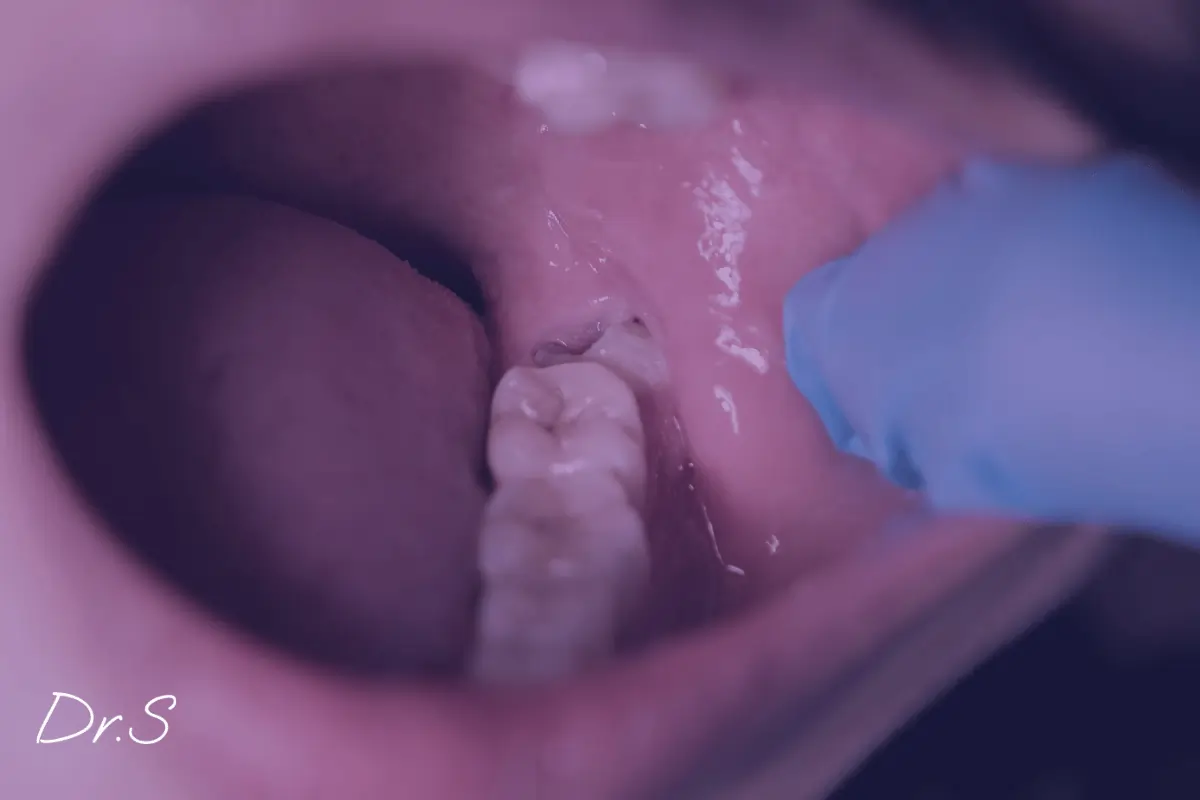
When you develop an abscess around a wisdom tooth, the pain often lies at the back of the jaw. It can be pulsating, increased by chewing or opening the mouth. When I examine it, I frequently find a red area, swollen, sometimes with a purulent flow at pressure.
The swelling of the gum may extend to the cheek or neck. Some patients also have bad breath, moderate fever or sensitive lymph nodes. All of these signs must alert, as they reflect an inflammatory reaction related to bacterial infection.
Differences with other abscess types
Abscesses related to wisdom teeth are often very different from those due to caries or periodontal lesions. In this case, the infection usually appears around a partially exited tooth, stuck under the gum, where bacteria accumulate easily.
These abscesses, called infected pericoronarites, mainly affect young adults. Unlike deep periapic abscesses, they are more superficial but can evolve rapidly without proper treatment.
Frequent causes of infection around a wisdom tooth
Pericoronarite and poor hygiene
The most common trigger factor remains the pericoronarite. This term refers to inflammation of the gum which partially covers a wisdom tooth coming out. When cleaning this area becomes difficult, a real bacterial trap is formed.
Food debris stagnates under this gingival cap, causing chronic irritation. In the absence of rigorous oral hygiene or professional cleaning, these bacteria infiltrate the tissues and trigger an abscess.
Positioning of wisdom teeth
What often strikes me is the major role of the tooth itself. A tooth that grows from the side, or that remains partially included, hinders the passage of brushing and opens a space favorable to infection.
In some cases, a half-cut tooth also creates friction against the nearby cheek or teeth, increasing trauma and inflammation locally. This anatomical configuration makes recurrences frequent if the underlying problem is not addressed.
When to consult quickly for an abscess of wisdom tooth?
Warning signs not to be ignored
Some symptoms warrant immediate consultation. If you experience intense pain, swelling that extends to the face or neck, fever, or if you have trouble opening your mouth (what is called a trismus), I advise you to come quickly in consultation.
This may indicate that infection is spreading to deeper structures. In my office at 7 rue Marbeau, I regularly welcome patients in this context, often worried about the rapid evolution of symptoms.
Risks of spread of infection
An untreated abscess is not always localized. It can evolve towards a facial cellulitis, which spreads infection to the tissues of the face and neck, or, in rare cases, to a more general infection affecting the whole organism.
Fortunately, these complications remain uncommon, provided that they occur in time. My role is then to assess whether a local gesture is enough, or whether it is necessary to associate a temporary antibiotic for dental abscess depending on your general condition and stage of infection.
I always recommend that my patients not wait for pain to intensify or for swelling to settle down to see quickly.
What treatments for an abscess of wisdom?
Local treatment and drainage of abscess
My first goal is to quickly relieve pain while stopping infection. When the abscess is accessible, I perform a local cleaning of the area associated with drainage, i.e. an evacuation of pus under local anesthesia.
Antiseptic mouth baths can complement these treatments to clean up the environment. In parallel, I will explain to you the hygiene gestures and instructions to follow during the following days.
Extraction of the wisdom tooth
When infectious episodes are repeated or the wisdom tooth is mispositioned, extraction may be necessary. This decision is never automatic. I propose it after a clinical and radiographic examination, taking into account your general condition, your history and precise tooth anatomy.
Removing an included wisdom tooth may prevent recurrence, but it is carefully preparing. I always take the time to accompany you in this indispensable reflection.
Antibiotic for dental abscess: when is it necessary?
Indications by infection status
I am often asked about the use of antibiotic for dental abscess. In my practice, I prescribe it only if the infection exceeds the local area, in case of fever, widespread swelling or risk of spread to other structures.
The antibiotic never replaces a mechanical treatment such as drainage or extraction. It is a temporary help, useful when the tissues are too inflamed to intervene immediately or to prevent worsening.
Choice of antibiotic and duration of treatment
Antibiotics most commonly used in this context include amoxicillin, sometimes associated with clavulanic acid. In cases of allergy, alternatives exist. The duration varies depending on the response to treatment, but is usually 5-7 days.
I always make sure that the chosen scheme is adapted to your medical profile, and I clearly explain the expected effects as the limits of this type of treatment.
Prevent recurrence after abscess of wisdom
Enhanced oral hygiene
Preventing a new infection depends first on simple but regular gestures. Brushing the area with wisdom teeth, even partially removed, remains essential. I often recommend using a small head brush and targeted mouthwash, at least temporarily.
If the area is difficult to access, a control consultation allows for in-depth disinfection and verification of gingival evolution.
Post-processing monitoring and regular checks
The key is to follow up after initial treatment. During the control consultations, I can monitor healing, evaluate tooth positioning and prevent recurrence.
It also stresses the importance of acting upstream: it is better to remove a tooth at risk under controlled conditions than to intervene in the emergency in full infection.
After an infected dental extraction: what care should be taken?
Post-operative care to be respected
After extraction, I systematically give precise instructions. Apply cold in the first few hours, avoid hard or hot food, and rest allow quick recovery.
Prescribed mouth baths from day two help maintain good local hygiene. These precautions are crucial to avoid alveolite or delayed healing.
Signs of complications to be monitored
If pain increases after a few days instead of decreasing, or if discharge persists, it is important to consult me again. A delay in healing or secondary infection may occur, even if it remains rare.
In case of doubt, I always prefer to reassess the situation rather than let a avoidable complication settle.
Recovery and return to normal life
Average recovery time
After treatment or extraction due to an abscess of wisdom tooth, recovery varies according to each patient. In general, it takes 3 to 5 days for simple gestures, and about a week to resume a completely normal life, especially in food.
Pain gradually decreases, and oral opening becomes fluid again as inflammation decreases.
Adapt your diet and habits
During this period, I recommend that we focus on soft, lukewarm, and easy to chew foods. Drinking plenty of water, avoiding alcohol and tobacco also facilitates healing.
I often remind my patients that sufficient rest and good hydration accelerate recovery. Listening to your body is also that, taking care of your oral health.
Facing a abscess of wisdomEvery hour counts. Early diagnosis, appropriate intervention and attentive listening enable effective action and anticipation of recurrence. Basically, it's not just about treating a tooth, it's about accompanying you on a lucid, human and sustainable care journey.
Patient-centred surgery in Paris

I am Dr Solène Vo Quang.
Every day, I explore what AI can bring to care, while remembering that the relationship with each patient remains our first therapeutic tool.
I provide care with rigour and transparency.



FAQ
Abscesses of wisdom
Answer your questions
Can you have a fever with an abscess of wisdom?

Yes, moderate fever may indicate an inflammatory response. It alerts about a possible spread of infection.
Can an abscess of wisdom repeat once drained?
Yes, if the tooth in question is not extracted or hygiene remains inadequate, a relapse is possible in the long term.
Can abscess cause pain beyond the mouth?
Some patients describe irradiation to the ear, eye or throat, a possible sign of local spread.
Is it risky to delay treatment for abscesses of wisdom?
Yes, a delay may expose to local or general complications. Rapid medical assessment is desirable.