
Wisdom Teeth Age: When Do They Usually Come Through?
The rash of wisdom teeth can surprise, cause pain or remain silent. And for many families, a question often comes up: at what age will these famous "third molars" appear, if they appear?
I am Dr Solène Vo Quang, an oral surgeon in Paris, specializing in, among other things, the wisdom teeth, both in their supervision and in their extraction. I regularly accompany teenagers and young adults at this particular time when these teeth begin to develop or pose problems. Understanding the age of wisdom eruption makes it possible to anticipate signs, reassure and sometimes intervene at the right time.
What is a wisdom tooth?
Definition and role in dental arcade
The wisdom teeth, also called third molars, are the last teeth at the bottom of the mouth, behind the second molars. They usually appear in adulthood, hence their name. In total, there may be one at each end of the upper and lower arcades, four in total.
Historically, they had a functional role: to help chew harder or less processed foods. Today, this function is less essential, especially in our modern, more flexible diet, which makes their presence sometimes problematic.
Evolution of the wisdom teeth throughout history
When we observe the evolution of the human jaw, we find that it has become shorter over generations. This change is linked to the evolution of diets and the decrease in the need to grind raw or fibrous foods.
Direct consequence: in many cases, there is simply more room for wisdom teeth to come out normally. This explains why they are so often associated with complications.
At what age do wisdom teeth appear?
Average age of eruption according to studies
On average, the wisdom teeth begin their eruption between the ages of 17 and 25. But there is great individual variability. In some, they can emerge from 15 years of age, while others will never see them out.
This " How old is the wisdom tooth So it depends as much on genetics as on local conditions within the jaw. There are also gender differences, with women sometimes having a somewhat earlier eruption.
Factors influencing age of onset
Several factors influence the age of appearance or even the total absence of these teeth. Genetics plays a key role, as does the bone structure specific to each individual. The nutritional environment during childhood, the space available in the jaw or even some ethnic origins can also weigh in the balance.
In my practice, for example, in adolescents who have had early orthodontic treatment, assessment of the space available for these molars is often anticipated.
Development of wisdom teeth: from formation to eruption
Third molar development phases
Before being visible, the wisdom teeth follow a long, often silent development. They begin to form in the bone at about 10-12 years of age. Their crown mineralizes first, then the root gradually builds.
The eruption itself occurs later, when the root reaches a certain length and the roots release it. However, this process can be interrupted at any stage if local conditions are not favourable.
Why Some Teeth Never Come Out
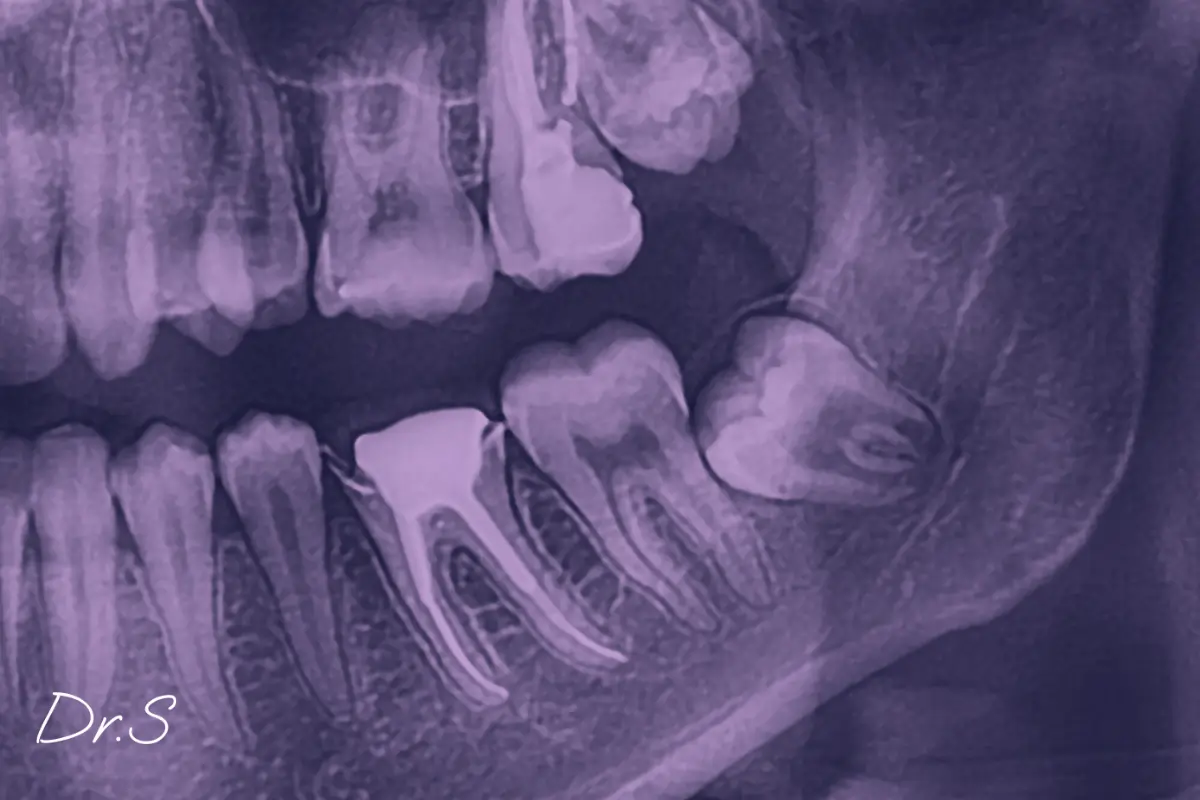
Often, wisdom teeth never pierce the gum. We then talk about included teeth. This can be explained by a lack of space, abnormal orientation or, in other cases, spontaneous interruption of development.
Sometimes they are only discovered during a radiological examination, during an orthodontic check-up or in connection with unexplained pain at the bottom of the jaw.
By explaining the stages of dental development, I can better accompany young adults in their choices.
What are the warning signs of a surge of wisdom tooth?
Common symptoms in adolescents and young adults
When a wisdom tooth is about to emerge, several symptoms may occur. You may experience deaf and localised pain at the bottom of the mouth, sometimes accompanied by inflammation or a feeling of tension in the gum.
In some patients, these signs go unnoticed. In others, they may be marked and prolonged, even disturbing sleep or chewing.
Difference between normal pain and complication
Pain accompanying a push can be normal, especially if moderate and transient. On the other hand, if it becomes intense, persistent or accompanied by fever, facial swelling or poor taste in the mouth, this may indicate a local infection, often due to inflammation of the gum around a tooth half-out.
In such cases, consultation is essential in order to assess the situation and prevent a more serious infection.
What problems can cause a wisdom tooth?
Including teeth, infections and cysts
Including a wisdom tooth can put pressure on the nearby tooth, cause hidden caries, or cause chronic pain. Infections are also common when a tooth is partially removed, creating a pocket for bacterial development.
More rarely, some cysts can form around the tooth. These lesions should be closely monitored and sometimes removed surgically.
When to consider extraction
I recommend extraction when there is a risk to dentition or general health, such as recurrent pain, local repeated infections or lesions on adjacent teeth.
The decision is always discussed on a case-by-case basis, based on clinical examination and accurate dental imaging, taking into account the patient's overall condition and history.
The wisdom tooth removal: what is the right time?
Clinical decision-making criteria
The criteria are often based on analysis of tooth evolution, its position, but also the associated clinical signs. 3D X-ray is a valuable tool for clarifying the relationships between root and nerves in the vicinity.
In my practice, I insist on a complete evaluation during any extraction decision: understand the benefits, anticipate possible complications and plan a surgical act under optimal conditions.
Optimal age for safe intervention
Extractions are often better tolerated between 16 and 25 years of age, when the roots are formed but still little anchored in the bones. This minimizes surgical follow-up.
Beyond this age, intervention is obviously possible, but sometimes requires more vigilance and more structured post-operative follow-up.
Answers to common patient questions
My child doesn't have a wisdom tooth yet, is it normal?
Yes, that can be quite normal. Some wisdom teeth appear only after 20 years of age, others remain included throughout life, and in some individuals they simply do not form.
Panoramic X-rays from 16-17 years old can help to assess their presence or not, and allow reasoned follow-up.
Can we prevent complications related to the push?
There is no miracle method to prevent a wisdom tooth from pushing wrong. On the other hand, I recommend that my patients have regular dental monitoring from adolescence, with panoramic radios if necessary.
Good oral hygiene is also an important protective factor, especially to avoid infections around partially excreted teeth.
What is the orthodontic impact of wisdom teeth?
Influence on dental alignment in young people
This is a question often asked after an orthodontic treatment: will wisdom teeth move aligned teeth? Actually, it's not systematic. Push can sometimes exert pressure that promotes dental movement, especially in cases of lack of space.
But it is necessary to qualify: other factors also influence the stability of the orthodontic result, such as the wearing or not of restraints, and the shape of the arcades.
Collaboration between orthodontist and dental surgeon
In many cases, I work closely with orthodontists to jointly plan the monitoring or extraction of third molars. This makes it possible to anticipate risks and avoid unnecessary interventions.
This interprofessional dialogue is essential to build an individualized care that respects the patient's path.
What to do after the eruption or wisdom tooth removal?
Precautions after extraction
After extraction, a few simple precautions help to promote healing. It is important to avoid mouthwashing in the first 24 hours, not to smoke, and to prefer a warm and soft diet for a few days.
I always offer post-operative follow-up to my patients, in order to answer their questions and verify that healing is taking its usual course.
Long-term monitoring for unextracted teeth
When choosing to leave a wisdom tooth in place, regular monitoring is essential, even if it has not yet given signs. This monitoring is based on periodic clinical and radiographic checks.
It makes it possible to anticipate a possible complication, to check that the tooth does not become a silent infectious home or that it does not disrupt the chewing mechanics.
Better knowledge of age of wisdom eruption means giving oneself the opportunity to act at the right time. Not all wisdom teeth are a problem, but all deserve to be looked at carefully. Because behind temporary pain or discomfort there are sometimes deeper issues: dental balance, general health and long-term quality of life.
Patient-centred surgery in Paris

I am Dr Solène Vo Quang.
Every day, I explore what AI can bring to care, while remembering that the relationship with each patient remains our first therapeutic tool.
I provide care with rigour and transparency.



FAQ :
The Tooths of Wisdom
Answer your questions
Is there a "normal" age window for the eruption of wisdom teeth?

Generally between 17 and 25 years, but this period may vary depending on genetic, environmental or bone development factors.
Does the absence of eruption in adulthood always mean a problem?
No. Some teeth remain included without a problem. A radiological assessment makes it possible to assess their position and possible risks.
Can wisdom teeth pierce after 30 years?
It's rare, but possible. Late rash may occur, especially if mandibular bone changes or a tooth begins to migrate.
Are there early markers of their development before they appear?
Yes, 3D or panoramic imaging from adolescence often makes it possible to observe their formation well before any visible eruption.