
Wisdom Tooth Pain: What You Need to Know
In some patients, the simple word "wisdom tooth pain" evokes a painful memory. And often it all starts with an x-ray and a question: "Is this tooth too big? »
I am Dr Solène Vo Quang, an oral surgeon in Paris, specializing in complex wisdom tooth removal and oral pathologies. In my practice at 7 rue Marbeau, I regularly accompany patients with whom the size of the wisdom tooth makes the procedure more delicate, and sometimes more painful.
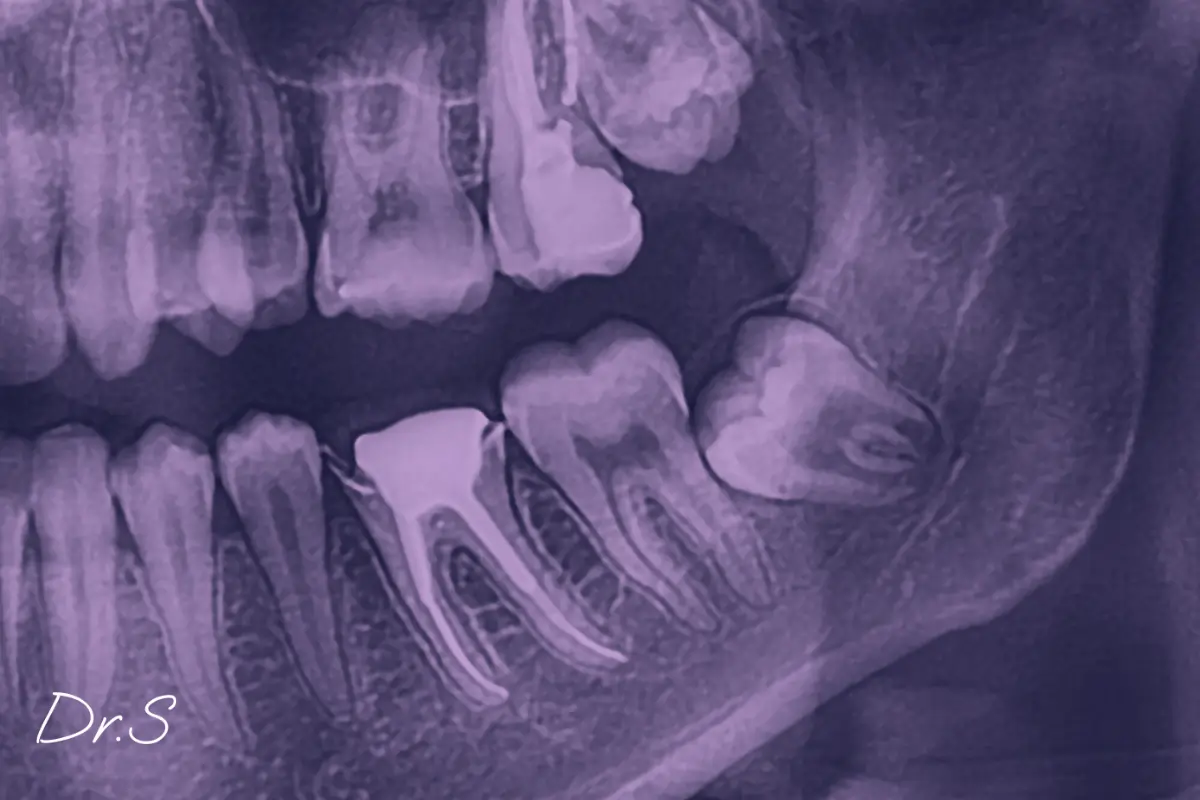
This parameter, which is often underestimated, has an important influence on surgical strategy, risk level and post-operative comfort. Let's just talk about it, so you can better understand what we see on your X-rays, and on what we base our decisions.
What are the size criteria for a wisdom tooth?
Factors influencing dimensions
There is no single size standard. The morphology of wisdom teeth depends on a combination of hereditary and anatomical factors. Some people naturally have small teeth, others have much more developed teeth, with several long or broad roots.
The bone volume available in the jaw, age, bone density and even tooth orientation also have a role. In some patients, the tooth does not have enough space to get out properly, which often results in asymmetric inclusion or development.
Normal size versus pathological size
A tooth is called "volumey" when it exceeds the average dimensions, oriented or not in the right axis, and especially when it conflicts with the surrounding structures.
It is not only the length of the root or the width of the crown that counts, but its whole: its integration into space, its functional impact and the risks it presents in the event of extraction. A large tooth is not necessarily problematic, but it often requires increased attention.
Why a great wisdom tooth often poses a problem
Risks associated with significant dental volume
The larger the wisdom tooth, the more likely it is to be enclaved or compress the inferior alveolar nerve, especially in the lower jaw. It can also exert pressure on nearby teeth, promoting infections or dental movements.
During extraction, this volume may require wider bone clearance, which increases the duration of the operation and recovery period.
Pain size and intensity
Large teeth often require greater tissue mobilization. This results in more severe local inflammation after extraction, and therefore prolonged pains the following days.
I often stress to my patients that it is not just a grubbing-up. In reality, it is a surgery sometimes comparable to small orthopedic surgery.
In my experience, patients feel more confident when they understand that the size of a tooth can change all management.
How to assess the size of a wisdom tooth on x-ray
Role of panoramic X-ray in analysis
Panoramic radiography is a first-intention examination. It offers an overall view of the position of the teeth, their apparent size and their proximity to sensitive structures such as the mandibular nerve or maxillary sinus.
It is from this cliché that we identify possible morphological anomalies, the risks of nervous contact and the criteria that can alert to a tooth extraction of complex size wisdom.
Reading coronary volume and roots
Two areas particularly attract my attention: the crown, which is the visible (or buried) part of the tooth, and the roots, which are often the key to the problem. A broad, curved or divergent root complicates the extraction gesture.
If the root is hook-shaped, or partially surrounds the nerve, then more precise and often longer surgical manoeuvres are required. 3D can sometimes be useful in refining this analysis when the situation is uncertain.
Complex extraction: what connection to the size of the wisdom tooth
When size complicates extraction
A very large tooth, or with several welded roots, intervenes on several sides of the operating difficulty: longer duration, wider bone exposure, increased mechanical stress, risk of fracture of the roots or surrounding los.
In these cases, intervention cannot be improvised, even if externally the tooth does not seem to be a problem. Anticipation is central to the safety of the gesture.
Surgical techniques adapted to large teeth
When the tooth is bulky, I usually use a controlled cutting technique. This involves cutting the tooth into several pieces to gradually remove it, minimizing the risks to neighbouring structures.
A wider bone edge may also be required, with a careful closure to promote healing. The gesture remains of course unaggressive, but it requires time, precision, and rigorous planning.
Complex cases: including teeth, large or with atypical roots
Curved roots or near the nerve
Some cases combine several difficulties: long roots, fine, curved, engaged around the nerve. We talk about a close relationship, and this involves great precautions to avoid post-operative nerve damage.
In these cases, I always take the time to inform the patient, discuss the benefits and risks, and propose an appropriate strategy, sometimes integrating post-surgical neurological follow-up as appropriate.
Plan intervention on a wide impacted tooth
A tooth included is a tooth that does not come out in the mouth. If it is more voluminous, the procedure sometimes resembles a small maxillofacial surgery. Planning becomes essential.
I'm using objective criteria to predict the difficulty: size on imaging, orientation, bone density, patient age. This upstream work allows me to choose the right moment of intervention and the most secure technique.
Post-operative complications related to the size of the wisdom tooth
Risk of alveolite and prolonged pain
The bigger the tooth, the larger the empty alveole. This can cause alveolite, a local inflammation sometimes very painful. The tissue takes longer to reform, especially if healing is disrupted.
Pain can also last a few days longer than after simple extraction. It is a common phenomenon that is anticipated by proposing preventive treatment adapted to each profile.
Specific post-operative monitoring
When I remove a big wisdom tooth, I systematically propose a control appointment to J+7. This helps to monitor healing, adjust painkillers if necessary, and reassure the patient of the expected evolution.
I also recommend applying local cold in the early hours, avoiding too early mouthwashing, and above all keeping in mind signs of infection. Good post-operative management greatly reduces complications.
Anticipate difficulty with operational indices
Clinical and radiological criteria to be monitored
Before every tooth extraction of large size wisdom, I rely on a set of clues. In the mouth, I look at the available space, the visibility of the tooth, the inflammatory signs. In X-ray analysis, the position, the morphology, the potential nervous contact.
These elements allow a fairly fine mapping of the level of difficulty, which allows me to build a safer, more tolerated intervention.
Use GAP score to estimate complexity
The GAP score is a tool that quantifys operational complexity by crossing objective criteria. It does not replace clinical analysis, but provides rigorous support for pre-operative evaluation.
I sometimes use it for ambiguous cases, when several risk factors add up. This makes it possible to document the situation and clearly explain the reasons for a more technical gesture or a strategic delay.
In my practice, I often recommend that patients not wait for pain to occur to consult. The earlier the intervention can be planned, the more favourable it is.
Conclusion
The size of the wisdom tooth is not a mere detail. It is fully involved in risk assessment, choice of operating techniques and appropriate post-operative monitoring. When this size is well identified upstream, extraction can be conducted more accurately, and therefore more serenity for you.
The most important thing remains, in my view, to take the time to listen to your feelings, your anxiety sometimes, and to propose a strategy that always remains focused on your safety and comfort.
Patient-centred surgery in Paris

I am Dr Solène Vo Quang.
Every day, I explore what AI can bring to care, while remembering that the relationship with each patient remains our first therapeutic tool.
I provide care with rigour and transparency.



FAQ :
Wisdom tooth size
Answer your questions
Is a very large wisdom tooth more likely to be impacted?

Not systematically, but a large volume associated with a lack of space increases the risk of bony impaction or unfavourable eruption.
Can the size of a wisdom tooth impact a nerve?
Yes, especially when the large roots are close to the inferior alveolar nerve visible on the panoramic X-ray.
Is a large wisdom tooth necessarily more painful?
Pain depends more on the inflammatory or compressive context than on the size alone, but a large volume may aggravate some symptoms.
Can we estimate the exact size of a wisdom tooth before extraction?
3D imaging allows accurate estimation of coronary and root dimensions, useful in anatomically complex cases.