
Why Remove Wisdom Teeth, and When Should They Stay?
Why remove wisdom teeth? This question often comes back in consultation, sometimes early in adolescence, sometimes later in adulthood, when pain or discomfort occurs. The subject seems simple, but it is not always.
I am Dr. Solène Vo Quang, an oral surgeon in Paris at 7 rue Marbeau, 75016, where I practice medicine and oral surgery. Wisdom teeth are one of the common reasons why my patients consult me, between decisions to make, tests to interpret and options to discuss calmly.
My approach is always individualized, based on a rigorous assessment of the dental, medical, but also personal context. Here you will find the broad lines that can guide your reflection on this sometimes delicate subject.
What are wisdom teeth and what are they for?
Definition and role of wisdom teeth
Wisdom teeth, also called third molar teeth, are the last teeth to erupt in the mouth, often between the ages of 17 and 25. There are usually four at the back of each dental arcade.
On the anatomical level, they are molars like others, designed to chew food. Their role was probably more important at a time when our diet was more fibrous and required prolonged and powerful chewing.
Why they're not always useful anymore
Over time, our diet has changed, becoming more flexible and less demanding for the jaw. In parallel, the average size of human jaws decreased due to this dietary and functional evolution.
As a result, these wisdom teeth often find little or no room to get out properly. This now gives them an ambiguous status, sometimes useful, but often problematic.
Why remove wisdom teeth: the most frequent indications
Lack of space and orthodontic disorders
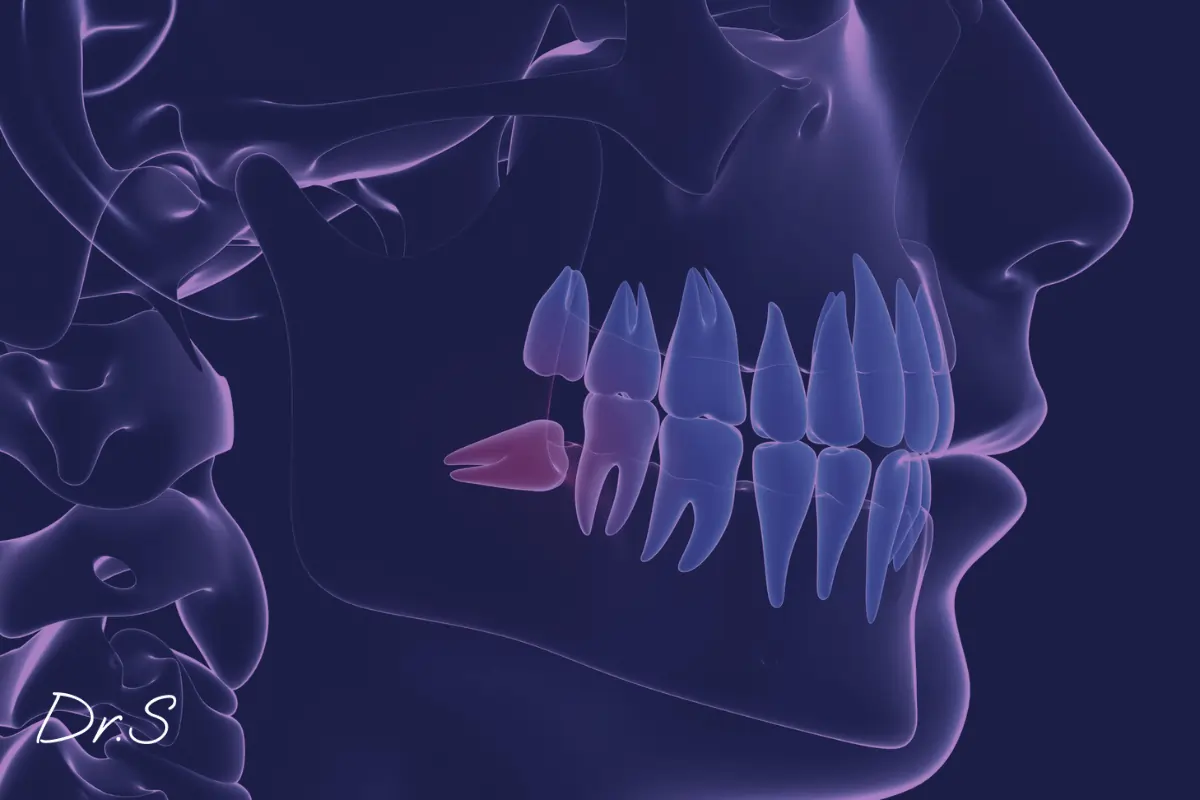
One of the most frequent situations where I am considering extraction with my patients is the lack of space. When wisdom teeth try to get out in an already saturated arcade, they can put pressure on neighbouring molars.
This pressure can cause dental displacement, sometimes visible on alignment or felt as discomfort. In some adolescents or young adults who have worn a device, this displacement may compromise the effects of past orthodontic treatment.
Infection, pain and inflammation
When wisdom teeth can only partially come out, they create an area that is difficult to clean, conducive to the development of bacteria. This can lead to local infections : the most common being pericoronarite, painful inflammation of the tissues around the tooth.
Patients then report pain, swelling, sometimes fever, or difficulty opening the mouth. In these cases, extraction becomes not only logical but often necessary to avoid more serious complications.
Why not remove wisdom teeth in some cases
When teeth are well positioned and functional
Some wisdom teeth come out in a perfectly aligned manner, without disturbing other teeth, and can be cleaned properly. When they are healthy, functional and well integrated into the arcade, there is no systematic reason to extract them.
In my practice, I prefer regular monitoring, with X-rays if necessary, to ensure that they remain stable over time.
Risks of preventive extraction
Extracting a tooth remains a surgical procedure, although it is often benign. Like any surgery, it carries risks: pain, infection, bleeding or, more rarely, nerve damage.
When extraction is done on a preventive basis, therefore without symptoms or pathology, these risks are to be weighed against the expected benefits. This is why it is essential not to generalise this decision, but to adapt it to each other's context.
Risks if wisdom teeth are not extracted in time
Damage to adjacent teeth, cysts and infections
Allowing a problematic wisdom tooth to evolve without intervention can expose to effects on nearby teeth. It can cause resorption of the root of the second molar, the appearance of caries, or promote the formation of cysts around its crown.
These cysts, although often benign, can sometimes cause local bone loss, which will then be managed. This is where surveillance plays a central role.
The importance of regular monitoring and reviews
Even a wisdom tooth that doesn't make her talk can be a problem over time. A panoramic X-ray often anticipates inclusion, a problematic axis or contact with a nervous structure.
In my practice, I often recommend a radiological examination in adolescence to serenely guide future decisions.
In case of unfavourable axes or warning signs, calmly discussing the interest of extraction at that time can avoid future complications.
What are the risks associated with wisdom tooth removal?
Post-operative pain, swelling and alveolites
Most often, the surgical follow-up is moderate: pain controlled by prescribed painkillers, slight swelling, discomfort in opening the mouth. A limited but unpleasant complication of the alveolite can occur if the blood clot dislodges after surgery.
It manifests itself in severe pain a few days after surgery. It deals effectively but sometimes requires a review visit to the firm.
Nervous injury and rarer complications
In rare cases, extraction can cause a near nerve injury, such as the inferior alveolar nerve. This can result in a temporary or, exceptionally, lasting loss of sensitivity of part of the lip or chin.
That's why I systematically rely on comprehensive imaging tests before any extraction, to precisely locate the risk structures.
How to decide: remove or preserve your wisdom teeth?
Medical criteria to assess with your dentist
Each patient is unique. The decision of an avulsion is based on several parameters: whether or not there is pain, repeated infections, tooth position, patient age, and tolerance to surgical risk.
An open discussion, supported by accurate clinical data, often makes it possible to choose the right time, or on the contrary, to confirm that no intervention is needed today.
The essential contribution of dental imaging
Imaging plays a central role. A panoramic X-ray gives a very useful overview, while a 3D scanner sometimes offers more detailed information, particularly about the proximity of a nerve or the precise shape of the roots.
I frequently use these tools to guide the decision in the most informed and secure way possible.
What to know about post-operative extraction and recovery
Surgery procedure
The extraction is carried out under local anesthesia. Depending on the position of the tooth, it may be simple or require a small opening of the gum. Duration and complexity vary depending on the inclusion and number of teeth involved.
In most cases, intervention is rapid and well tolerated. The patient leaves the same day, with clear post-operative instructions and planned follow-up.
Good practices to recover well
During the following days, I advise my patients to avoid hard or too hot foods, to maintain adequate oral hygiene without brushing the area immediately, and to scrupulously follow the prescribed treatment.
In case of persistent intense pain, fever or severe swelling, a quick consultation allows me to check that no complication is installed.
The impact of extraction on orthodontics
Prevent recurrence after treatment
Sometimes sharp wisdom teeth influence, even weakly, the stability of an orthodontic treatment completed a few years earlier. This is not always the case, but it is a point that I often address with the patients concerned.
A precise assessment then makes it possible to anticipate possible dental displacement and to ask the question of early withdrawal.
Creating space for alignment
In some orthodontic treatments, especially in the case of small jaws or grouped teeth, planned wisdom tooth removal helps to free space for proper alignment.
The decision is then taken in close coordination with the orthodontist, to integrate this step into a comprehensive treatment strategy.
Ultimately, removing wisdom teeth is neither automatic nor unique. It is a dialogue, supported by clinical examination, imaging and your personal situation.
My role as an oral surgeon is to accompany you in this decision, at your own pace, by asking the right questions and putting your health at the heart of every choice.
Patient-centred surgery in Paris

I am Dr Solène Vo Quang.
Every day, I explore what AI can bring to care, while remembering that the relationship with each patient remains our first therapeutic tool.
I provide care with rigour and transparency.



FAQ
Why remove wisdom teeth
Answer your questions
Can a wisdom tooth disturb a tooth already treated or crowned?

Yes, so poorly oriented, it can exert pressure on an adjacent tooth, even restored, and compromise its stability or the integrity of a crown.
Why are we talking about "included" wisdom teeth and how does it guide the extraction decision?
A tooth included remains under the gum or in the bones; Depending on its position, it may remain asymptomatic or cause complications to be monitored.
Can wisdom teeth be retained if hygiene is good and sufficient spaces are available?
Yes, if they are well positioned, available for brushing and without pathological impact, regular monitoring may be sufficient.
Why can removing wisdom teeth be discussed even without visible symptoms?
Some lesions evolve silently; 3D imaging helps to anticipate invisible complications in the clinic, hence the interest of informed advice.