
Oral dermatology: diagnosis and specialist care

A mouth lesion that does not go away deserves specialist advice
A persistent lesion, discomfort on the tongue, pain with no obvious cause: the oral mucosa can manifest very different diseases, some of which require prompt care. In Paris, Dr Solène Vo Quang examines the lesion, establishes a diagnosis and directs you to appropriate treatment, in liaison with your dentist and general practitioner.
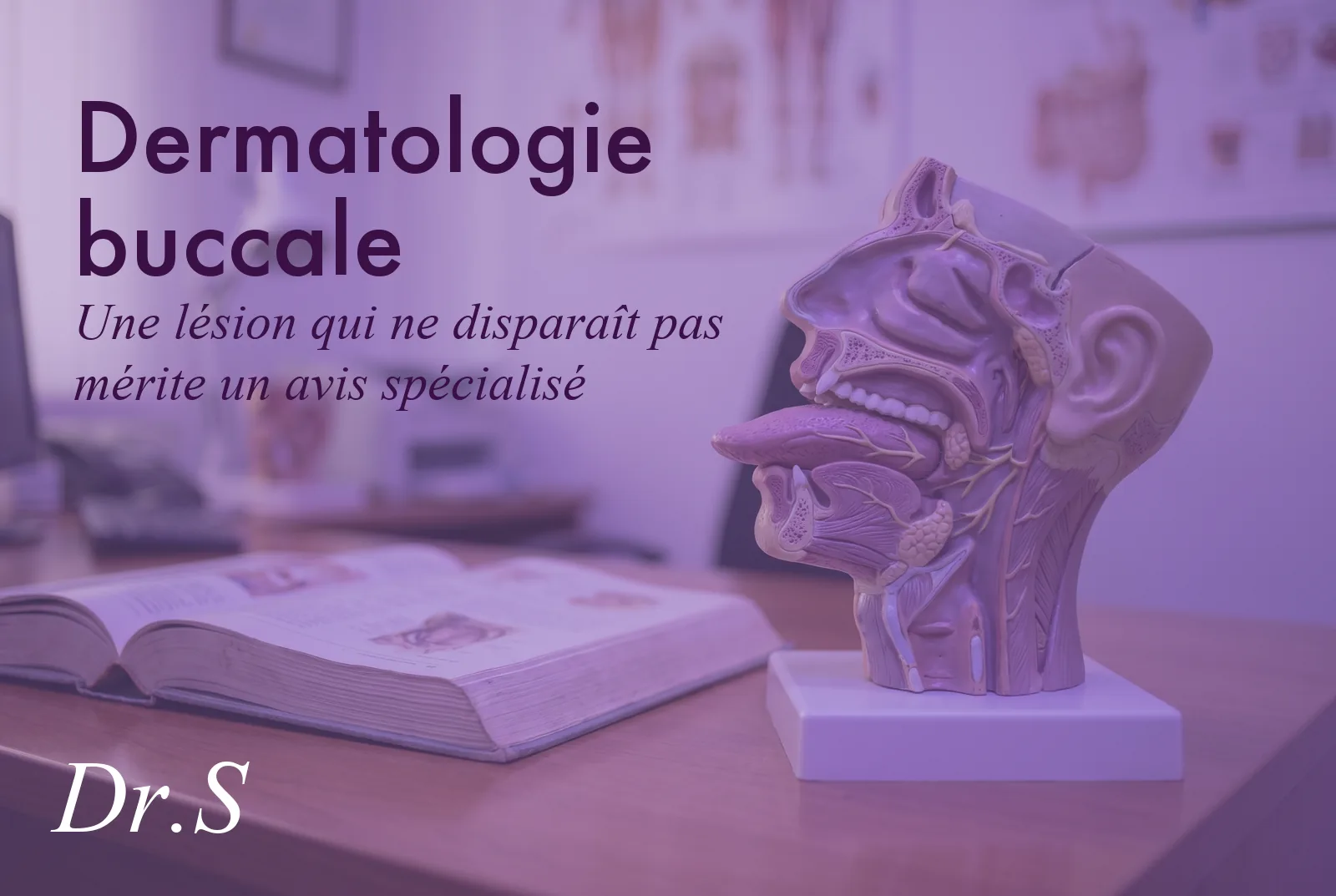
When the mucosa sends a signal
The mouth is a place where both local and general diseases can manifest. The same lesion may be benign or require urgent care: only an examination, sometimes supplemented by a biopsy, can determine which.
The lesion that does not go away
A canker sore, a white or red patch, an ulceration lasting more than two weeks: duration is the most important criterion, well before pain.
Pain without a dental cause
Burning of the tongue, a dry-mouth sensation, a metallic taste. Your dentist finds nothing on the teeth, yet the discomfort is very real.
Lesions that come back
Recurring canker sores, cyclical flare-ups, gum involvement: recurrence points to a possible general cause that needs to be investigated.
Warning signs
Induration, bleeding on contact, a persistent lymph node, a spreading lesion. These signs require prompt advice and, if necessary, a sample.
I am Dr Solène Vo Quang, a stomatologist in Paris, specialising in the diagnosis and management of diseases of the mouth. My medical approach is based on attentive listening and a comprehensive assessment of the patient, with thoughtful use of 3D imaging tools and specialist examinations. Oral dermatology, although little known, plays an essential role in this approach.
What is oral dermatology?
Medical definition of oral dermatology
Oral dermatology concerns conditions affecting the mucous membranes of the mouth: the inside of the cheeks, the tongue, the gums, the palate and the lips. It lies at the intersection of several disciplines, notably oral medicine, dermatology and otolaryngology.
In my practice, it enables me to identify oral lesions that are due neither to dental hygiene nor to a purely mechanical cause, but sometimes to a systemic condition, dermatological or infectious.
Difference between oral pathology and oral dermatology
There is often confusion between “oral pathology” and “oral dermatology”. In practice, oral pathology includes all diseases that can affect the oral cavity, from the most common to the rarest. Oral dermatology, on the other hand, focuses specifically on mucosal conditions, often visible to the naked eye as patches, ulcerations or redness.
These two fields are complementary. To establish a precise diagnosis, I often combine a detailed clinical examination with imaging examinations or tissue analyses.
Types of lesions seen in oral dermatology
White, pigmented and erythematous lesions
Certain oral mucosal lesions manifest themselves through changes in colour. White lesions, such as leukoplakia, require monitoring because some of them can progress to precancerous forms. Other abnormalities take the form of pigmented patches, sometimes benign, sometimes linked to an underlying condition. Red or erythematous lesions may indicate chronic inflammation or infection.
My role is to sort, analyse and put things into context. Any persistent or evolving lesion deserves serious assessment. ✅
Ulcerations, nodules and swellings
Oral ulcerations are common, but their cause is not always trivial. A canker sore, a traumatic lesion, herpes, or sometimes the manifestation of a broader disease: the diversity of causes makes a medical assessment essential.
I am also required to examine nodules or swellings in the mouth, such as mucoceles, abscesses or certain benign tumours. Their consistency, appearance and location guide the diagnosis, but a biopsy may be necessary to remove any uncertainty.
Origins of conditions affecting the oral mucosa
Local and traumatic factors
The oral mucosa is constantly exposed to contact, humidity and various irritants. An ill-fitting prosthesis, repeated biting, a poorly tolerated piercing or traumatic brushing can be enough to create persistent irritation, or even a chronic lesion.
When I suspect a local factor, I assess the oral environment as a whole, in relation to the patient’s history. A lesion that always recurs in the same place, for example, may suggest an area of friction that needs to be corrected.
Systemic or autoimmune diseases
Some diseases affect the mouth even though their origin is much broader. This is the case with lupus, Crohn’s disease or lichen planus. When you have several symptoms in different parts of the body, oral lesions can become a clue to the diagnosis.
In these cases, I work with other specialists — dermatologist, gastroenterologist, allergist — to shed light on the whole picture and determine the best therapeutic approach. ⚠️
Diagnosis in oral dermatology: stages and tools
Clinical examination of the oral cavity
The visual examination remains central. I take the time to observe every area: cheeks, tongue, floor of the mouth, palate, gums… The slightest abnormalities of colour, texture and symmetry must be identified.
I also ask you many questions: how long has it been there? Does it bother you when you eat? Have you noticed a change? These discussions enable me to refine my clinical suspicion.
Biopsy, imaging and additional tests
When observation is not enough, I use more in-depth examinations: a mucosal biopsy for microscopic analysis, a blood test to explore an immune origin, or imaging to assess the extent in depth.
These tools are never imposed; they are always explained. I make sure that each stage of the diagnostic pathway is understood and chosen in consultation with you.
During a consultation, I always take the time to explain each lesion and the reasons for the proposed examinations, to help you feel confident.
Treatment of oral conditions: options and follow-up
Medical treatments and surgical approaches
Treatment depends on the diagnosis. Some lesions respond to local treatment — antifungal, corticosteroid or antiseptic — while others require surgery if they persist or if their nature is uncertain.
I perform minor procedures in the practice, such as resection of small benign lesions under local anaesthesia, or I refer patients to an oral and maxillofacial surgery department in more complex cases.
Prevention of recurrences and long-term monitoring
A lesion is not limited to a one-off episode. Certain diseases of the oral mucous membranes tend to recur or evolve slowly. This is why I often recommend monitoring over time, even after visible symptoms have disappeared.
In practice, I ask my patients to tell me about any reappearance, however slight, and I sometimes offer regular follow-up every 6 to 12 months — depending on the identified risk.
When should you consult a specialist in oral dermatology?
Here is a question I am often asked: “At what point should you worry?” In reality, any oral lesion that persists for more than two weeks with no obvious cause should lead you to seek advice. The same applies if pain is unusual, if an area of your mouth changes in appearance, or if you feel discomfort when speaking, chewing or swallowing.
I always prefer to see a benign lesion too early rather than a concerning lesion too late. Early diagnosis makes all the difference. ✅ If in doubt, do not hesitate to seek advice.
Conclusion
The mouth is an often neglected area, yet it can reveal many conditions. Oral dermatology enables targeted, reasoned and humane care for these conditions, sometimes silent, sometimes chronic, often worrying for those who live with them.
Taking the time to understand what is happening in the oral mucosa is the essence of my work. And while science evolves, it will never replace the attention given to your history, your symptoms and your questions.
Patient-centred surgery in Paris

I am Dr Solène Vo Quang.
Every day, I explore what AI can bring to care, while remembering that the relationship with each patient remains our first therapeutic tool.
I provide care with rigour and transparency.



Key takeaways
Four reference points for knowing when to consult and what to expect
Watch how long it lasts
Any oral lesion that persists for more than two weeks warrants an examination, even if it is not painful.
Establishing a diagnosis
Clinical examination, follow-up photographs and, if necessary, a biopsy: the sample resolves uncertainty when appearance alone is insufficient.
Treating the cause
Local treatment, correction of an irritant, management of a general disease: the response depends on the diagnosis made.
Moving forward together
Dentist, dermatologist, general practitioner, stomatologist: a coordinated pathway for tailored care.
Our guides to conditions of the mouth
Every situation has its own page. Find the one that matches yours.
Lesions and bumps
The mucous membranes
Oral cancer
The tongue
BOOK AN APPOINTMENT
Book an appointment with a stomatologist in Paris
A stomatologist assesses conditions that may require specialist care, including oral surgery, lesions of the mouth or tongue, sleep apnoea and complex wisdom teeth. This first consultation helps establish what is happening and discuss the next steps before any treatment decision.
We listen to you
Tell us about your pain, discomfort, concerns about a lesion or difficulty sleeping. You can raise any question during the consultation.
We examine the problem
A clinical examination, with imaging if needed, helps assess your situation.
A clear plan to take home
You leave with an explanation of the findings and, where appropriate, a treatment plan and written estimate. You can take time to consider the proposed care.
Choose an appointment
Appointments via Doctolib
FAQ — Oral dermatology
We answer your questions

Pain such as burning, tingling or dry-mouth sensations may indicate underlying dermatological disorders.
Yes, certain conditions such as lichen planus or oral candidiasis can also affect children and require appropriate care.
Good oral hygiene, stopping smoking and regular follow-up limit the risk of diseases of the mucous membranes developing.
A specialist stomatologist or a dermatologist trained in oral conditions can establish an initial diagnosis and direct care.