
Wisdom tooth stitches: purpose, types, aftercare and complications

After a wisdom tooth extraction, you will often look at your gum and wonder whether ‘everything is normal’. Wisdom tooth stitches reassure many patients, yet they are not always used and do not, on their own, tell you whether healing will be straightforward.
L'essentiel
- Quand : 2 à 3 jours après l'extraction, la douleur s'aggrave au lieu de diminuer.
- Où : surtout après une dent de sagesse du bas.
- Que faire : appeler le cabinet. On nettoie l'alvéole et on pose un pansement.
- Antibiotique : pas d'antibiotique pour une alvéolite sèche.
- Urgence : 15 ou 112 en cas de fièvre, de visage ou de cou très enflé, ou de difficulté à avaler ou à respirer.
Qu'est-ce qu'une alvéolite ?
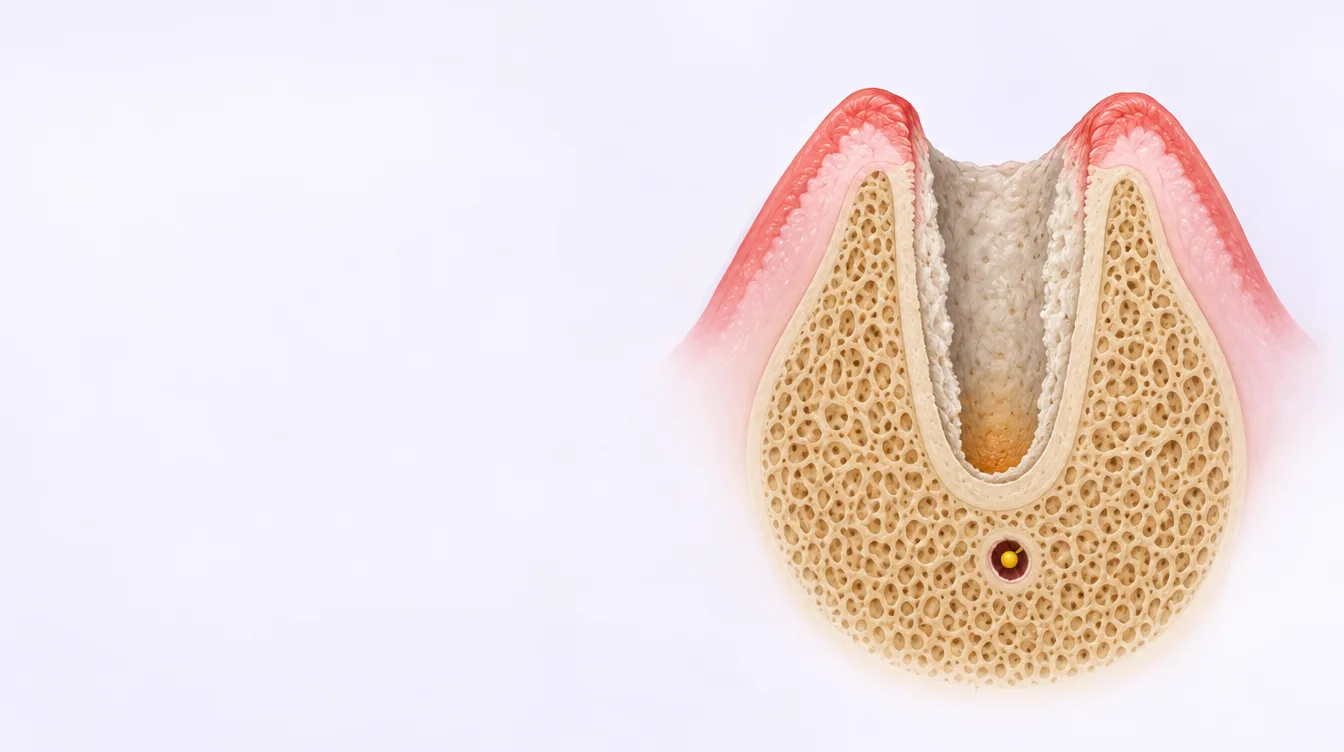
Quand on enlève une dent, il reste un trou dans l'os : l'alvéole. Un caillot de sang s'y forme dans les heures qui suivent. Il protège l'os et sert de base à la cicatrisation. Dans l'alvéolite, ce caillot ne se forme pas ou se détache. L'os de l'alvéole reste alors à nu, ce qui est très douloureux. C'est une complication connue de l'extraction, plus fréquente après une dent de sagesse du bas (MSD ; HAS 2019).
Comment la reconnaître ?
Le signe qui doit alerter, c'est le moment où la douleur apparaît. Après une extraction, elle diminue en général au bout de deux à trois jours. Dans l'alvéolite, c'est l'inverse : elle s'aggrave brusquement après ce délai, et elle peut gagner l'oreille (MSD).
| Suites normales | Alvéolite possible | |
|---|---|---|
| Évolution de la douleur | Maximale les premiers jours, puis elle diminue | Elle repart ou s'aggrave après 2 à 3 jours |
| Où | Autour de la zone opérée | Au fond de l'alvéole, parfois vers l'oreille |
| Que faire | Suivre l'ordonnance et les conseils post-opératoires | Appeler le cabinet |
Le gonflement des premiers jours fait partie des suites habituelles : voir le gonflement après extraction.
Alvéolite sèche ou alvéolite suppurée
- Alvéolite sèche : la forme la plus courante, celle décrite plus haut. L'alvéole est vide, l'os est exposé, la douleur est vive.
- Alvéolite suppurée : l'alvéole s'infecte.
La HAS distingue ces deux formes parce que leur traitement n'est pas le même (HAS 2026). Si l'infection s'étend, avec du pus, une joue qui gonfle, une bouche qui s'ouvre mal ou de la fièvre, voir aussi l'infection après extraction.
Le traitement au cabinet
On nettoie doucement l'alvéole, puis on y place un pansement qui protège l'os et calme la douleur (MSD). La douleur est ensuite prise en charge par un antalgique adapté, prescrit par le praticien.
Pour une alvéolite sèche, la HAS ne recommande pas d'antibiotique. Un antibiotique se discute seulement si l'infection s'étend (HAS 2026). Le praticien décide après vous avoir examiné.
En attendant le rendez-vous
- Appelez le cabinet : une alvéolite se soigne au fauteuil, pas à la maison.
- Prenez l'antalgique comme indiqué sur votre ordonnance, sans augmenter les doses.
- Ne fumez pas.
- Continuez les soins d'hygiène prescrits, en douceur.
- Appelez le 15 ou le 112 en cas de fièvre, de visage ou de cou très enflé, de peau rouge et chaude, ou de difficulté à avaler ou à respirer (ameli).
Peut-on l'éviter ?
- Bain de bouche ou gel à la chlorhexidine après l'opération : il est recommandé pour prévenir l'alvéolite (HAS 2019). Le praticien vous dit lequel et pendant combien de temps. Voir quel bain de bouche après une extraction.
- Ne pas fumer avant et après l'extraction (MSD).
- Respecter les conseils des premiers jours : ce qu'on peut manger, la glace, la cicatrisation.
Au cabinet du Dr Vo Quang
Si vous avez été opéré au cabinet et que la douleur repart, appelez-nous : vous êtes reçu rapidement, sous 48 h. Consultation 150 €, secteur 2 : remboursement partiel par l'Assurance maladie et votre mutuelle selon votre contrat, sans garantie de remboursement intégral. 7 rue Marbeau, 75016 Paris. Prendre rendez-vous · 01 42 73 79 01.
Questions fréquentes
Comment savoir si on a une alvéolite ?
La douleur repart ou s'aggrave 2 à 3 jours après l'extraction au lieu de diminuer, parfois jusqu'à l'oreille. Seul l'examen au cabinet le confirme.
L'alvéolite est-elle une infection ?
La forme la plus courante, l'alvéolite sèche, est un défaut de cicatrisation : le caillot manque et l'os est à nu. Il existe aussi une forme suppurée, infectée.
Faut-il des antibiotiques ?
Pas pour une alvéolite sèche, selon la HAS. Seulement si l'infection s'étend, sur décision du praticien.
Est-ce que l'alvéolite guérit seule ?
Il ne faut pas attendre : le pansement posé au cabinet soulage et protège l'os. Appelez le cabinet.
À quoi ressemble un caillot normal ?
Après une extraction, l'alvéole se remplit d'un caillot de sang sombre qui la protège. Il ne faut ni le toucher ni rincer fort les premiers jours.
Combien de temps dure une alvéolite ?
Ça dépend de chaque cas. Le praticien vous dit comment la douleur doit évoluer après le pansement et quand revenir.
Comment éviter une alvéolite ?
Bain de bouche ou gel à la chlorhexidine selon la prescription, pas de tabac, et respect des conseils des premiers jours.
Sources
- HAS. Avulsion des 3es molaires : indications, techniques et modalités, mai 2019. PDF
- HAS. Prescription des antibiotiques en pratique bucco-dentaire, juillet 2026. PDF, copie de l'ARS PACA
- Manuel MSD, grand public. Complications après des soins dentaires. Page
- Assurance Maladie. Que faire et quand consulter en cas de mal de dent. Page
- Kademani D., Tiwana P. Atlas of Oral and Maxillofacial Surgery, 2e éd., Elsevier, ch. 10-12.
I am Dr Solène Vo Quang, a stomatologist (a doctor specialising in oral surgery) in Paris, at 7 rue Marbeau (75016). I regularly remove wisdom teeth in my practice, and above all I try to give you practical guidance, without being alarmist, but without playing down what needs to be monitored either. If your question is about a piece of thread sticking out or when the stitches fall out, see the page stitch threads after wisdom tooth removal.
Wisdom tooth stitches: what are they for after the extraction?
Stitches are threads that bring the edges of the gum together to help it close up properly. I may place them after an extraction to protect the area, stabilise healing and make the first few days more comfortable, but I may also decide not to use any if the site closes well on its own.
There are several approaches, each with its merits. The decision depends on the position of the tooth, the technical difficulty and your circumstances (for example, if you bleed easily or your gum is fragile).
Aims: closing the gum, stabilising the clot, limiting bleeding
After the extraction, a blood clot forms in the socket, in other words the ‘housing’ of the tooth in the bone. This clot is precious, because it acts as natural protection and as the foundation for healing.
Stitches bring the gum together and help keep this clot in place. They can also limit minor oozing and make healing ‘cleaner’ in the first few days, particularly when the gum has had to be moved.
When stitches are common: impacted or sideways tooth, gum flap, wide socket
I place stitches more often when the tooth is impacted (still in the bone) or lying on its side, or when an incision was needed and a small flap of gum had to be lifted to reach the tooth. They are also common when the socket is wide, or if a little bone had to be removed to free the tooth, which is called an osteotomy.
In these situations, closing the gum properly reduces the areas where food can get trapped and gives better control of bleeding. It does not make the procedure miraculous, but it can make the early stage of healing more secure.
Stitches and dry socket: what difference do they really make?
Dry socket is a painful complication linked to loss of the blood clot or poor healing of the socket. Stitches can help protect the clot, but on their own they are not enough to prevent dry socket.
In real life, the factors that matter most are often smoking, rinsing too vigorously, suction (straws, repeated spitting), overly rough cleaning or, on the contrary, neglected hygiene. My role is to explain this delicate balance to you: protect without sealing in, clean without causing damage.
What types of stitches are used after wisdom tooth removal (dissolvable or not)?
Patients often ask me ‘What kind of stitches did I have?’, and it is a good question. Understanding which type was used helps you make sense of what you feel, and know whether they will need to be removed.
There are dissolvable stitches, which break down on their own, and non-dissolvable stitches, which need to be removed at the practice. The choice depends on how much stability is needed, the area and the type of closure.
Dissolvable stitches: how long they last, advantages, materials used
Dissolvable stitches are designed to disappear gradually. In practice, they may loosen, fray a little or come away in small pieces, which is often normal as long as the gum stays well closed and the pain is easing.
Their main advantage is convenience, because they do not necessarily need to be removed. That said, I may still suggest a check-up if you have discomfort, if a thread is pricking your cheek, or if you are unsure about how the area looks. In my practice, above all I want you to know what is normal and what needs prompt advice.
Non-dissolvable stitches: when they are used and how they are removed
I choose non-dissolvable stitches when I want the gum to be held very reliably, for example where the closure is under more tension, or when the area needs to be well stabilised. They are usually removed after a few days, at a check-up, but the exact timing depends on how you are healing.
Removal is usually quick and easier to tolerate than people imagine. The post-operative check-up also has a medical purpose: making sure there is no infection, checking the socket, and adjusting the advice if the area is hard to clean.
How long do stitches stay in, and when do they fall out?
In short. Dissolvable stitches fall out on their own, usually within 1 to 3 weeks. Non-dissolvable stitches are removed at the check-up, 7 to 10 days after the extraction. The surface of the gum closes in 7 to 10 days; the bone underneath takes several weeks to a few months.
I prefer to be transparent: there is no single timetable that applies to everyone. The gum, the bone, your general health and the type of extraction all affect the timing.
What I can give you are simple benchmarks. The idea is to help you avoid two common pitfalls: worrying too early, or waiting too long when something is wrong.
Healing times: gum versus the ‘hole’ (socket)
The surface of the gum closes faster than the bone rebuilds underneath. Even if the ‘hole’ looks alarming, the socket fills in gradually, and this bone process is slower.
The more complex the extraction, the longer the area may stay tender and uneven. Smoking, some pre-existing inflammation or difficulty keeping the area clean can also slow healing. The step-by-step detail is on the page healing time, day by day; the hollow left after the extraction is explained on the page wisdom tooth healing.
When to plan the check-up: signs that healing is going well
When things are going well, you will usually notice pain that eases day by day, bleeding that stops, and swelling that levels off and then goes down. Some slight difficulty opening your mouth may be present at first, but it tends to improve.
On the other hand, if the pain clearly increases again after a few days, if a very strong smell develops, or if you have a fever or discharge, it is best to contact me again without waiting. These situations are easier to manage the earlier they are dealt with.
Gum stitches: how long before they fall out?
A dissolvable stitch loosens, frays and then comes away in small pieces, often during the second week, sometimes not until the third. You may find it while eating or brushing your teeth: this is normal. If it is still there after three weeks and bothers you, a check-up is all that is needed to remove it. More details on when the stitches fall out.
Aftercare: protecting the stitches and speeding up healing
After an extraction, you have one simple goal: protect the clot and avoid irritating the area. ‘Fast’ healing is not a race; it is more a series of small, consistent choices, especially in the first few days.
In my practice, I often repeat that cleaning should be gentle and regular, not aggressive. You do not need to ‘scrub’ the wound, but you should not let it get dirty either.
Checklist for the first 48 hours: what really helps
For the first 48 hours, rest and cold applied to the outside of the cheek (in short periods) often help to limit oedema, in other words swelling. If it bleeds, biting on a clean gauze pad with steady pressure works better than repeated rinsing.
As for food, I generally advise soft textures, lukewarm or cold, and avoiding foods that get stuck. I also ask you to avoid straws and vigorous rinsing, because suction can dislodge the clot. For what comes next, see when to eat solid food after an extraction.
Days 3 to 7: hygiene, mouthwash, gradual return to normal
From the third day, oral hygiene becomes central again. Brush gently around the area; you can clean without pressing on the wound, letting the gum gradually get stronger.
Mouthwashes are only useful if they are prescribed and used correctly, because rinsing too much can be counterproductive. I prefer a light rinse, without ‘gargling’, especially after meals, rather than a forceful one that irritates and causes bleeding. Prescribed mouthwashes start from the second day; to choose one, see which mouthwash to use after a tooth extraction.
Pain, swelling, trismus: what to take and when to worry
Moderate pain, swelling and trismus (difficulty opening the mouth) can be expected, especially after a more technical extraction. Painkillers should be taken as indicated on the prescription, and it is better to stay ahead of the pain than to let it set in.
However, pain that becomes throbbing and very severe, swelling that increases instead of going down, or significant difficulty swallowing or breathing call for prompt advice. My aim is for you to be able to tell normal discomfort from a warning sign.
Stitches that come loose, bleed or bother you: what should you do?
It is common for stitches to be a little bothersome, especially as the swelling goes down and the thread becomes more ‘noticeable’. The most important thing is not to pull on them, even if they itch or catch.
Here are some practical pointers for everyday situations. The idea is not for you to become a surgeon, but for you to have safe reflexes.
A painful stitch: is it normal?
In the first few days, the gum is swollen and the stitch pulls: a tugging feeling or a mild burning sensation around the thread is common. It eases as the swelling goes down. A thread rubbing against the cheek can also cause irritation: the end can be trimmed at the practice. What is not normal: pain that increases after the third day, a very red and warm gum, pus or fever. In that case, call the practice.
A thread that pricks, a stitch coming undone, bad breath: common causes
A thread that pricks the cheek is often due to a slightly protruding knot, or to a thread that has loosened. Bad breath can come from food debris trapped near the socket or around the stitches, especially if you avoid brushing for fear of touching the area.
You can rinse gently, keep up regular hygiene, and avoid touching the area with your fingers or any object. If a stitch comes undone but the gum stays broadly in place, it is not necessarily serious, but I would rather you asked my advice if the wound opens or the pain increases.
Bleeding: what to do and mistakes to avoid
If there is bleeding, the right response is simple: a clean gauze pad, steady pressure, your head slightly raised, and rest quietly. What keeps bleeding going is often repeated spitting, alcohol, physical exertion too soon, and smoking.
If the bleeding continues despite properly applied pressure, or if it becomes heavy, you should contact me again. I would always rather have one call ‘too many’ than a situation that gets worse at home.
Warning signs: infection, fever, increasing pain, dry socket
Some signs should alert you: fever, pus, hot and painful swelling, or pain that clearly increases again after two to four days. A very unpleasant taste, a strong smell that persists, or pain spreading towards the ear can also suggest dry socket.
In these cases, monitoring yourself is not enough. A clinical examination confirms what is happening and allows the right treatment to be started, sometimes simply local cleaning and targeted measures. If you did not have your operation at the practice and the situation cannot wait, see the page emergency stomatologist.
Wisdom tooth removal without stitches: for whom and in which cases?
I am often asked whether a wisdom tooth can be removed without stitches. Yes, it is sometimes possible, but it is neither a goal in itself nor a guarantee of better healing.
I choose this option when the extraction is simple and the gum settles back into place naturally, without tension. The priority remains safe healing, not the absence of stitches.
Criteria: simple extraction, clean socket, natural closure
An extraction without stitches is more feasible when the tooth has already come through, access is direct and there is no need for a large flap. I also check whether the socket is clean, whether the bleeding is well controlled, and whether the gum can close on its own.
In some cases, even if the extraction seems ‘simple’, your anatomy or the condition of the tissues may lead me to prefer a few stitches. This is a case-by-case decision, discussed before the procedure.
Benefits and limits: comfort, hygiene, risk of bleeding/dry socket
Having no stitches can improve comfort and make cleaning easier, because nothing rubs against the cheek. On the other hand, the area may be more exposed in the first few days, and you need to follow the advice on protecting the clot even more carefully.
With or without stitches, the risk of bleeding or dry socket depends mainly on following the advice, on smoking, and on how the area is cleaned. I always try to be clear: technique matters, but what you do at home matters too.
The check-up after the extraction: what it is for
The post-operative check-up is not a meaningless routine. I usually see you again 7 to 10 days after the extraction. It is used to check healing, to remove non-dissolvable stitches if they were placed, and to adjust the hygiene advice according to how the area actually looks.
In the meantime, make a note of what you observe: how the pain changes day by day, the swelling, your temperature if you feel feverish. A photo taken without touching the wound can help you describe the situation when you call. Patients feel calmer when they know what to look for and when to call.
When you call the practice: 4 questions to save time
When you call, four pieces of information are enough to decide in under a minute whether home-care advice is sufficient, whether a prompt appointment is better, or whether you need to be referred as an emergency.
I find this approach useful because it brings some method to a moment when emotions can easily take over. It also protects the patient, by avoiding playing down an important sign.
4 questions in 60 seconds: bleeding, pain, fever, mouth opening
I look for concrete information. How much blood can you see: is it just a trickle, or bleeding that fills your mouth? How bad is the pain, and is it worse than the day before?
I also ask whether you have a measured fever, and whether your mouth opening is very limited, which is called trismus. These simple questions give an objective picture of the situation and avoid misunderstandings.
Decision: self-care, prompt appointment or emergency
If the bleeding is light and can be controlled with a gauze pad, the pain is easing and you have no fever, home-care advice with monitoring may be enough. If the pain clearly increases again, if the smell is very strong, if you can barely open your mouth, or if the bleeding persists, a prompt appointment is the safer option.
And if you have difficulty breathing, swelling that is spreading quickly, or heavy bleeding that cannot be controlled, you need urgent care.
With clear benchmarks on wisdom tooth stitches, normal recovery and warning signs, you can go through healing with more peace of mind. All the instructions for before and after the operation are gathered in the aftercare advice for wisdom tooth removal.
FAQ: wisdom tooth stitches
Dr Solène answers your questions
Do wisdom tooth stitches change the risk of dry socket?
They protect the clot and the gum, without ‘guaranteeing’ that dry socket will not occur. What matters most is still hygiene, not smoking, and follow-up if the pain increases.
Can I brush my teeth and use mouthwash with wisdom tooth stitches?
Yes, gently: use a soft toothbrush, without rubbing the operated area for 48 hours. Mouthwashes start from the second day, without gargling hard and without spitting.
A thread that pricks or a stitch that ‘gapes’ after an extraction: is it serious?
Often not. A thread can irritate the cheek and is easily trimmed at the practice. However, if you have persistent bleeding, a bad smell, fever or increasing pain, call the practice.
Which signs mean I should call urgently after wisdom tooth stitches?
Pain that increases after the third day, swelling that keeps spreading beyond 48 hours, a temperature above 38 °C, bleeding that does not stop with pressure, or numbness of the lip or chin that persists. Difficulty breathing or swallowing means you must call 15 (the emergency medical service in France).
How long do stitches stay in the gum?
Dissolvable stitches fall out on their own within 1 to 3 weeks; non-dissolvable stitches are removed at the check-up, after 7 to 10 days.
How are wisdom tooth stitches removed?
Do not remove them yourself. Dissolvable stitches fall out on their own; the others are removed at the practice, in a few seconds, during the check-up.
Patient-centred surgery in Paris

I am Dr Solène Vo Quang.
Every day, I explore what AI can bring to care, while remembering that the relationship with each patient remains our first therapeutic tool.
I provide care with rigour and transparency.


