Wisdom tooth germectomy: removing the tooth bud before the tooth forms

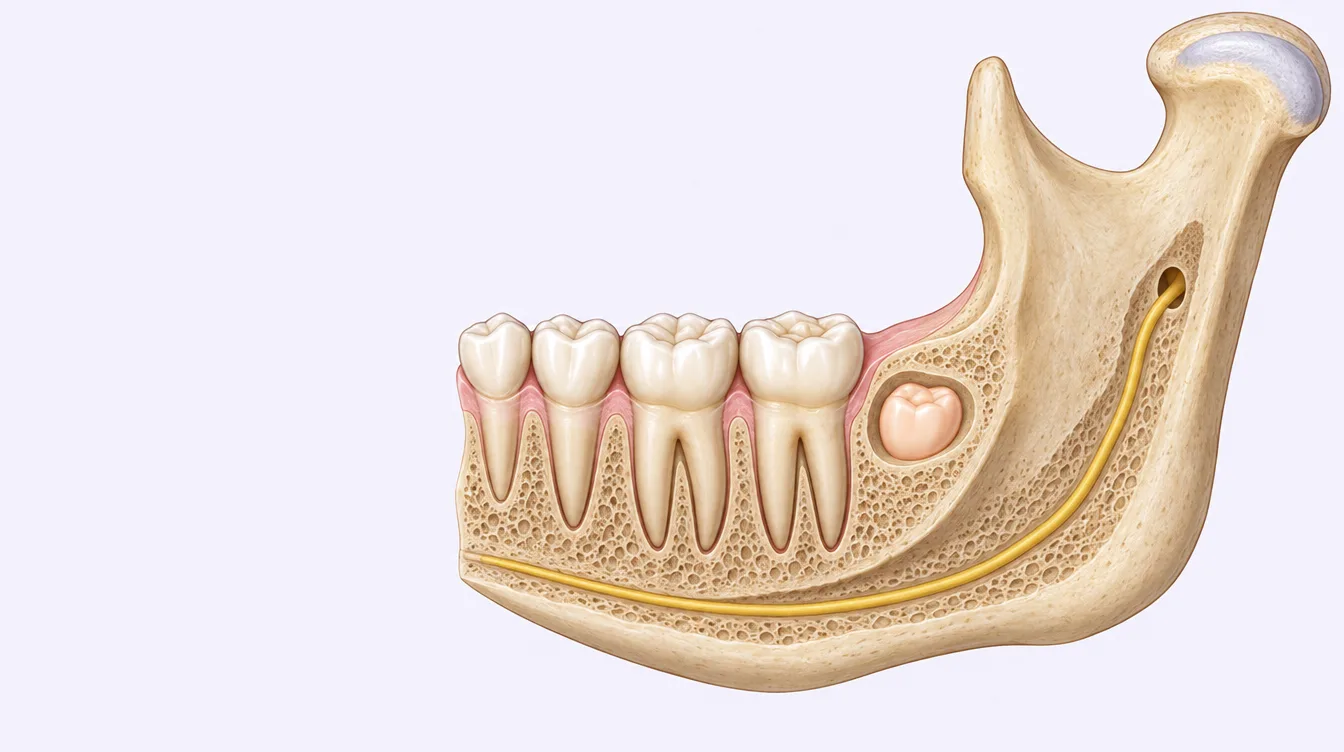
A germectomy is the removal of a wisdom tooth while it is still only a tooth bud: a crown forming in the bone, with no roots. It is mostly discussed during adolescence, often after a panoramic X-ray. The French National Authority for Health (HAS) makes one simple point: it is not removed as a matter of principle. The first step is to check that it cannot find its place.
What is a wisdom tooth bud?
The 32 permanent teeth come in between the ages of 6 and 18: the first molar around 6, the second around 12, the third, the wisdom tooth, around 18. Before it comes through, the wisdom tooth forms in the bone: first the crown, then the roots, which lengthen over several years. As long as the roots have not formed, it is called a tooth bud. The full timeline is on the page at what age wisdom teeth come through
Why is it discussed during adolescence?
The French National Authority for Health (HAS, 2019)
What does not justify a germectomy
Has it been mentioned to you? We discuss it at the consultation, with a panoramic X-ray: the space available, the angle of the tooth bud, its distance from the nerve, what is useful now and what can wait.
Germectomy now or extraction later?
There is no single answer: the decision is made case by case, weighing benefit and risk. If the tooth is kept, the HAS recommends monitoring with a clinical examination and a panoramic X-ray every 2 years, until the roots have formed (around 25-30). A tooth that becomes infected, decays or damages its neighbour falls under the usual reasons for removing a wisdom tooth
How it works for a teenager at the practice
Recovery
The most common after-effects of removing a wisdom tooth are pain, swelling and difficulty opening the mouth (HAS 2019). They are described, with useful steps, in pain after a wisdom tooth extraction
Frequently asked questions
What is a germectomy?
The removal of a wisdom tooth while it is still a tooth bud, that is, before its roots have formed.
At what age is a germectomy done?
There is no single age: it is discussed when the X-ray shows the tooth bud and the question of space arises. The HAS recommendations cover children from the age of 12 and adults; at the practice, teenagers are seen from the age of 15 with a parent.
Should it be removed if it does not hurt?
Not as a matter of principle. It must first be checked that it cannot develop favourably. Some situations justify acting early, such as roots that would form close to the nerve.
I have been advised to have them removed to keep my teeth straight. Is it useful?
The HAS does not recommend removing a wisdom tooth to prevent the front teeth from overlapping. Other reasons may exist: we look at them together.
Can all 4 be removed at the same time?
Yes, generally in a single session.
Is it done under anaesthetic?
Yes, under local anaesthetic; the type of anaesthesia is discussed at the consultation.
How much does the consultation cost?
€150 (medical specialist, sector 2), with partial reimbursement by French national health insurance and your top-up insurance, with no guarantee of full reimbursement. The quote for the procedure is given at the consultation.
Sources
French National Authority for Health (HAS). Removal of third molars: indications, techniques and procedures
Martinet C., Dakpé S., Kün-Darbois J.-D. (eds). Chirurgie maxillo-faciale et stomatologie. Réussir ses EDN. Elsevier Masson, chapter on tooth eruption (in French).
Kademani D., Tiwana P. Atlas of Oral and Maxillofacial Surgery, 2nd ed., Elsevier, chapter 12 (impacted teeth), US source.
Patient-centred surgery in Paris

I am Dr Solène Vo Quang.
Every day, I explore what AI can bring to care, while remembering that the relationship with each patient remains our first therapeutic tool.
I provide care with rigour and transparency.


